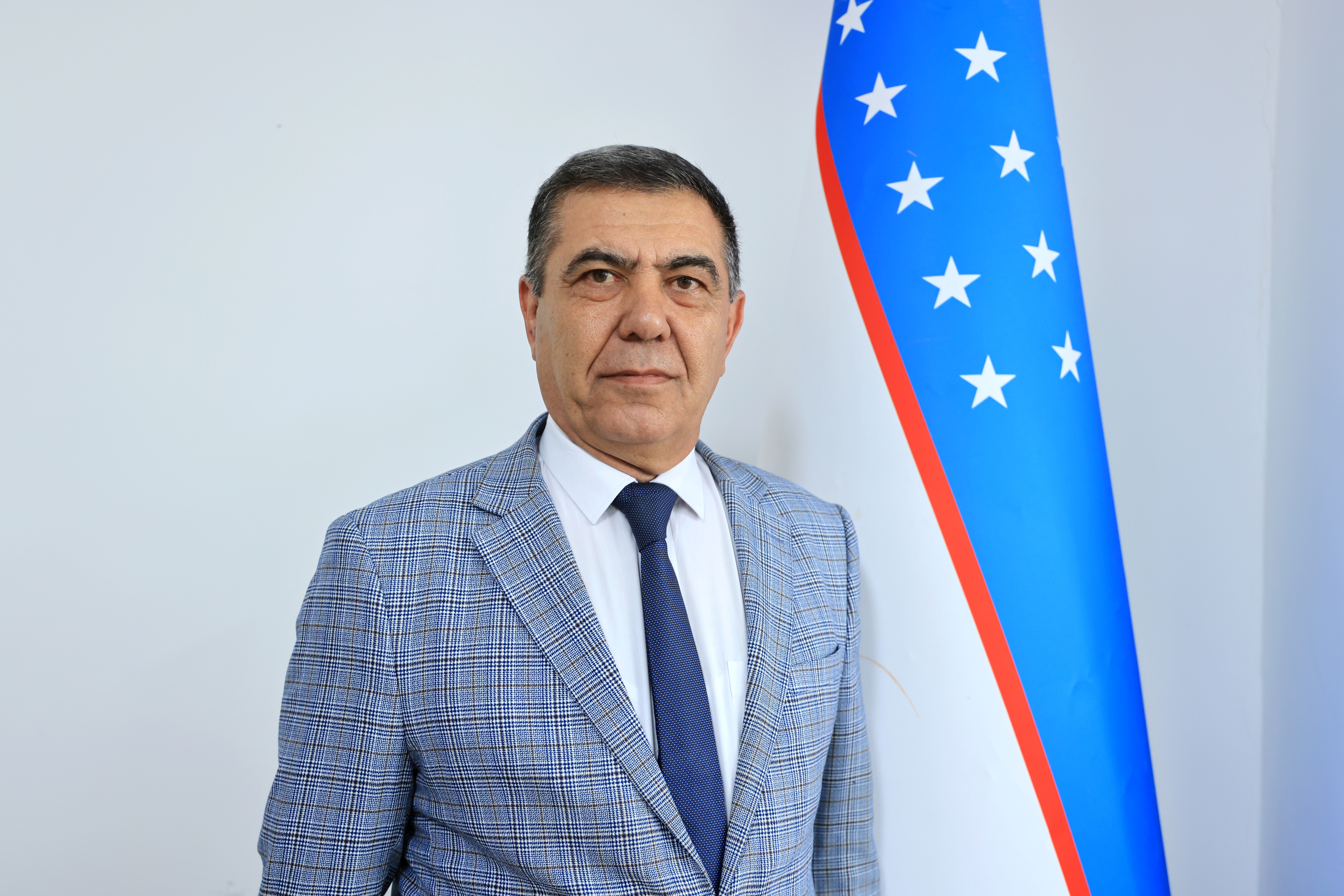
Head of the Department of Industrial ecology and Hydrogeology
Khaitov Rauf Arifovich
Qabul vaqti: Tuesday-Friday ( from 14:00 to.16:00 )
Telefon: (91) 405-66-24
Email: sanoat_ekologiyasi@mail.ru
In accordance with Resolution No. PQ-22 of the President of the Republic of Uzbekistan dated January 24, 2025, “On the Establishment of Bukhara State Technical University,” closely related departments were reorganized, and as a result of the restructuring of the Department of Industrial Ecology of the Bukhara Engineering-Technological Institute and the Department of Hydrology and Ecology of the Bukhara Institute of Natural Resources Management, the Department of Industrial Ecology and Hydrology was established and commenced its activities. The Department prepares highly qualified specialists with modern knowledge and professional skills to meet the needs of the economic sectors of Bukhara region, including industry, engineering, oil and gas, transport and logistics, green economy, environmental protection, inclusiveness, and socio-economic development of territories. Training is conducted at the bachelor’s and master’s levels in the following academic programs: Meliorative Hydrogeology; Hydrology (Hydrology of Rivers and Reservoirs); Ecology and Environmental Protection (in Water Management); Ecology and Occupational Safety and Technical Safety; Occupational Safety and Technical Safety (by sectors).
The faculty members of the Department of Industrial Ecology and Hydrology, in accordance with their areas of specialization, deliver courses based on standard and working curricula in the following disciplines: “Industrial Ecology” (for all technical and technological fields), “Life Safety and Occupational Protection,” “Construction Ecology,” “Ecology,” “Life Safety” (for all technical and technological fields), “Occupational Protection and Ecology,” “Industrial Sanitation and Occupational Hygiene,” “Protection of Economic Facilities in Emergency Situations,” “Fire and Explosion Safety,” “Occupational Safety Management,” “Technogenic Risk and Reliability of Technical Systems,” “Life Safety and Environmental Protection,” “Psychology and Culture of Occupational Protection,” “Innovative Technologies in Industry,” “Occupational Protection and Technical Safety,” “Engineering Ecology,” “Radiation Safety,” “Occupational Protection and Construction Ecology,” “Occupational Protection and Technical Safety,” as well as Hydrology of Rivers, Lakes and Glaciers; Environmental Impact Assessment; Engineering Geology and Hydrogeology; Drilling Operations and Irrigation Wells; SOF; SOG; Land Hydrology; Climatology; Instrumental Methods of Analysis; Environmental and Water Law; Hydrochemistry; Environmental Monitoring; Ecology and Environmental Protection; Meliorative Hydrology; Geology and Hydrogeology; Water Law; Monitoring in Water Intake Wells; Engineering Hydrology; Hydrography of Central Asia; Water Resources Management; Waste Management; Environmental Engineering; International and National Water Relations; Hydrometry; Operational Hydrometry; Groundwater Flow; Drilling Operations; GIS and Hydrology.
Head of the Department Rauf Arifovich Khaitov
Associate Professor Bakhodir Temurovich Mukhamadiev
Associate Professor Botir Khamroevich Salomov
Associate Professor Jahongir Akhmatovich Do'stov
Associate Professor Ismoil Islomovich Fattoev
Associate Professor, PhD (Technical Sciences) Nasiba Murodovna Bakhriddinova
Senior Lecturer Yoqub Yodgorovich Hamidov
Senior Lecturer Mohira Djuraeva Zaripova
Senior Lecturer Nargiza Nigmatovna Tursunova
Assistant Mirshod Toshpo‘latovich Qurbonov
Assistant Shohista Abdurashidovna Xolova
Assistant Feruza Rakhmatovna Kamolova
Doctoral Candidate Mehriniso Baxronovna Axmedova
Doctoral Candidate Xabiba Toshevna Tuxtayeva
Associate Professor Tamara Ivanovna Atamuratova
Associate Professor Barno Baxridinovna Qobulova
Bachelor’s Degree Programmes
60520200-Ecology and Environmental Protection
61020200-Occupational Safety and Technical Safety
60530800-Hydrology (Hydrology of Rivers and Reservoirs)
60812600-Meliorative Hydrogeology
60710400-Ecology and Environmental Protection (in Water Management)
61020200-Occupational Safety and Technical Safety (by Sectors)
Master’s Degree Programmes
71020201-Occupational Safety and Technical Safety
70520202-Ecology
1. Monitoring of Population Employment
2. Environmental Impact Assessment
3. Environmental Protection and Green Development
4. Environmental Impact Assessment
5. Environmental Protection
6. Economics of Environmental Resources
7. Fundamentals of Sustainable Development
8. Bioecology
9. Biogeography
10. Rational Use of Biological Resources
11. Biology and Microbiology
12. Pre-Graduation Internship
13. Waste Management
14. Environmental Audit
15. Environmental Expertise
16. Modeling of Ecological Processes
17. Environmental Management
18. Environmental Management and Audit
19. Environmental Monitoring
20. Environmental Education and Upbringing
21. Environmental Hazards
22. Ecology
23. Fundamentals of Ecology
24. Environmental Law
25. Ecology and Environmental Protection
26. Ecology and Life Safety
27. Operational Hydrometry
28. Electrical Safety and Rules for the Operation of Electrical Installations
29. Fundamentals of Ergonomics
30. Safety in Emergency Situations
31. Civil Protection
32. GIS and Hydrology
33. Methods of Geoecological Research
34. Fundamentals of Geographic Information Systems
35. Geology and Geomorphology
36. Geology and Hydrogeology
37. Hydrogeological and Meliorative Monitoring and Cadastre
38. Hydrography
39. Hydrochemistry
40. Hydrological Forecasting
41. Hydrological and Meliorative Forecasting
42. History of Hydrological Research
43. Hydrology, Hydrogeology and Engineering Geology
44. Introduction to Hydrology
45. Hydrometry
46. Life Safety
47. Life Safety and Ecology
48. Protective Equipment and Devices
49. Research Work and Master’s Thesis (SEG)
50. Scientific and Pedagogical Work (SEG)
1. Tuxtayeva X.T., Rakhmatov Yu.B. Fundamentals of Landscape Studies. Textbook. 2025.
2. Tuxtayeva X.T. Introduction to the Specialty. Textbook. 2025.
3. Egamberdiyev M.S., Imomov Sh.J., Tuxtayeva X.T., Davidov N.R. Geology and Hydrogeology. Textbook. 2023.
4. Egamberdiyev M.S., Tuxtayeva X.T., Jumayeva T.A. Engineering Geology and Hydrogeology. Textbook. 2023.
5. Do‘stov J.A., Radjabova M.M. Hydrological and Meliorative Forecasting. Volume I. Textbook. 2025.
6. Axmedova M.B., Axmedova O.B., Nazarov R.A., Yoqubov M.E. “Fire and Explosion Safety.” Textbook. Volume II. 2023.
7. Axmedova M.B. “Fire and Explosion Safety.” Textbook. Volume I. 2022.
8. Axmedova M.B. “Life Safety.” Textbook. 2021.
9. Tursunova N. “Construction Ecology.” Textbook. 2023.
10. Fattoyev I.I., Salomov B.H., Sodiqov I.Sh. Industrial Ecology. Textbook. 2021.
11. Do‘stov J.A., Radjabova M.M. Hydrological and Meliorative Forecasting. Study Manual. 2024.
12. Tuxtayeva X.T., Rakhmatov Yu.B., Hakimov Sh.H. Climatology. Study Manual. 2023.
13. Do‘stov J.A., Isayev S.X., Tadjiyev S.S., Djumanazarova A.T. Pasture Melioration. Study Manual. 2024.
14. Salomov B.H. Instructional and Methodological Guidelines for the Course “Life Safety.” 2022.
15. Do‘stov J.A., Radjabova M.M. Resource-Saving Irrigation Regimes for Soybean Varieties under Conditions of Saline Meadow-Alluvial Soils. Monograph. 2025.
16. Dustov J.A., Radjabova M.M. Development of a Resource-Saving Irrigation Regime for Soybean Varieties under Conditions of Saline Meadow-Alluvial Soils (on the Example of the Bukhara Region). International Monograph. 2024.
17. Tuxtayeva X.T. Zoning of Temporary Flowing Water Bodies of the Central Kyzylkum. Monograph. 2022.
18. Combating Desertification through the Rational Use of Local Water Resources (on the Example of the Central Kyzylkum). International Monograph. 2023.
1. Tursunova N.N., Methods for Eliminating Accidents and Fires. Proceedings of the Scientific and Practical Conference entitled “Reforms in the State Fire Safety Service – A Step Towards a New Stage.” Tashkent, March 30, 2018. pp. 143–146.
2. Tursunova N.N., The Use of Bread in the Daily Human Diet. “Engineering and Technology of Food Production.” Proceedings of the XII International Scientific and Technical Conference (Mogilev, April 19–20, 2018). Volume 1, pp. 214–215.
3. Tursunova N.N., The Importance of Proper Nutrition Organization for Young Athletes. “Engineering and Technology of Food Production.” Proceedings of the XII International Scientific and Technical Conference (Mogilev, April 19–20, 2018). Volume 1, pp. 324–325.
4. Tursunova N.N., Adaptation of Students to Extreme Natural Situations. “Engineering and Technology of Food Production.” Proceedings of the XII International Scientific and Technical Conference (Mogilev, April 19–20, 2018). Volume 2, pp. 415–416.
5. Tursunova N.N., Wastewater Treatment of Food Industry Enterprises. “Engineering and Technology of Food Production.” Proceedings of the XII International Scientific and Technical Conference (Mogilev, April 19–20, 2018). Volume 2, pp. 423–424.
6. Tursunova N.N., Air Pollution as a Threat to Environmental Security in Uzbekistan. “Engineering and Technology of Food Production.” Proceedings of the XII International Scientific and Technical Conference (Mogilev, April 19–20, 2018). Volume 2, pp. 425–426.
7. Tursunova N.N., The Disappearance of the Aral Sea as an Environmental Problem of Uzbekistan. “Engineering and Technology of Food Production.” Proceedings of the XII International Scientific and Technical Conference (Mogilev, April 19–20, 2018). Volume 2, pp. 427–428.
8. Tursunova N.N., The Importance of Electronic Interactive Boards in the Educational Process. Proceedings of the Republican Scientific and Practical Conference entitled “Woman and Time.” May 23, 2018. pp. 173–175.
9. Tursunova N.N., The Comprehensive Nature of Innovations in the System of Additional Professional Education. “Scientist of the XXI Century” International Scientific Journal, No. 6-3 (41), June 2018. pp. 45–46.
10. Tursunova N.N., Formation of Environmental Education Among Youth. “The Role of Science and Education in Solving Environmental Problems.” Proceedings of the Republican Scientific and Practical Conference (September 8, 2018). pp. 48–49.
11. Tursunova N.N., Protection of Atmospheric Air from Motor Vehicle Emissions. “The Role of Science and Education in Solving Environmental Problems.” Proceedings of the Republican Scientific and Practical Conference (September 8, 2018). pp. 94–95.
12. Tursunova N.N., Electrical Equipment of Fire- and Explosion-Hazardous Premises and Outdoor Installations. “The Role of Science and Education in Solving Environmental Problems.” Proceedings of the Republican Scientific and Practical Conference (September 8, 2018). pp. 96–98.
13. Tursunova N.N., Liability for Violations of Environmental Legislation. Republican Scientific-Theoretical Conference entitled “Environmental Culture: Problems and Solutions.” Bukhara, 2025. pp. 176–178.
14. Tursunova N.N., The Role of Environmental Innovations in the General Education System. Republican Scientific-Theoretical Conference entitled “Environmental Culture: Problems and Solutions.” Bukhara, 2025. pp. 50–53.
15. Tursunova N.N., The Role of Environmental Education in the General Education System. Republican Scientific-Theoretical Conference entitled “Environmental Culture: Problems and Solutions.” Bukhara, 2025. pp. 15–17.
16. Tursunova N.N., Structure of the Department of Food Quality and Safety. “Development of Science and Technologies: Scientific and Technical Journal.” 2025. No. 2/2025. pp. 230–233.
17. Tursunova N.N., Employer Liability for Damage to Employees’ Health in Case of Violation of Labor Conditions. International Modern Scientific and Practical Journal “News of Education: Research in the XXI Century,” No. 31 (100), February, Part 1, Moscow, 2025. pp. 228–232.
18. Tursunova N.N., Soil Resources and Their Erosion Under the Influence of Wind. International Scientific and Technical Conference entitled “Colloid Chemistry: Innovations and Solutions for Chemical Technology, Ecology and Industry” (Section 2), February 7–8, 2025. pp. 936–939.
19. Tursunova N.N., The Environmental Status of New Uzbekistan. International Scientific and Technical Conference entitled “Colloid Chemistry: Innovations and Solutions for Chemical Technology, Ecology and Industry” (Section 4), February 7–8, 2025. pp. 318–322.
20. Tursunova N.N., Main Sources of Pollution. Republican Scientific and Technical Conference Proceedings entitled “Innovative Solutions to Technological Problems in the Extraction and Processing of Oil, Gas and Gas Condensate.” Bukhara, November 14–15, 2024. pp. 424–426.
The Department cooperates with the UN FAO Organization, the European Union’s Erasmus+ Program, Iowa University (USA), the University of Wyoming (USA), Niagara College (Canada), the University of Surrey (United Kingdom), Humboldt University of Berlin (Germany), the Polytechnic University of Valencia (Spain), the Polytechnic University of Turin (Italy), the University of Rome (Italy), the University of Szeged (Hungary), Óbuda University (Hungary), the Hungarian University of Agriculture and Life Sciences (Hungary), the University of Cyprus (Cyprus), the Belarusian State Technical University (Republic of Belarus), the K.A. Timiryazev Moscow State Agrarian University (Russian Federation), Kursk State Agrarian University (Russian Federation), Middle East Technical University (Türkiye), Uşak University (Türkiye), Seoul National University (Republic of Korea), INTI International University (Malaysia), and M. Auezov South Kazakhstan University (Republic of Kazakhstan).
In cooperation with the above-mentioned institutions, it is planned to establish a Scientific Research Center for “Modeling, Simulation and Prototyping.”
At the initiative of Lanzhou University of the People’s Republic of China, a “Dust Forecasting” device laboratory was established at the University using grant funds amounting to 130,000 US dollars.
A Memorandum of Cooperation has been signed between the Department and M. Auezov South Kazakhstan State University. Associate Professor Daurenbek Nazarbek Mukhaddasuly of the Department of Ecology at the partner university and Associate Professor Lokhanova Kulzoda Mergenovna of the Kazakh-Turk University (Kazakhstan) have been engaged as scientific consultants to the Department. In addition, student and faculty exchange programs have been established between the higher education institutions.
1. Prospective Activities to Further Improve the Quality of the Educational Process:
1. Introducing curricula and academic literature of foreign higher education institutions ranked in the TOP-300 into the educational process.
2. Improving curricula and relevant regulatory and methodological documents in accordance with international standards and the requirements of employers when organizing the educational process.
3. Implementing a system of training specialists based on joint educational programs in cooperation with leading foreign higher education institutions ranked in the TOP-500.
4. Implementing the DUAL education model in selected fields based on foreign experience in cooperation with foreign organizations (enterprises).
5. Introducing a system of teaching students based on the DUAL education model in order to improve the quality of personnel training.
6. Developing new-generation educational literature, introducing it into the educational process, and ensuring the continuous updating of the Information Resource Center fund.
7. Developing students’ critical and creative thinking, systemic analytical skills, and entrepreneurial competencies.
8. Establishing and organizing branches of specialized departments on the basis of partner organizations.
9. Organizing short-term professional development (internship) programs for professors and instructors teaching specialized subjects at national production enterprises and organizations.
10. Expanding mutually beneficial and effective cooperation with leading foreign higher education institutions worldwide.
11. Improving criteria for assessing students’ knowledge, skills, and competencies.
12. Expanding the international student contingent by attracting students from foreign countries and organizing teaching activities of department faculty members at foreign higher education institutions.
13. Organizing the educational process for foreign and local university students within the framework of academic mobility programs.
14. Ensuring that university graduates establish their place in society as competitive and highly qualified specialists.
15. Directing scientific research toward solving sectoral problems, expanding integration, and ensuring research effectiveness.
16. Increasing the scope of scientific work by organizing research internships for researchers.
17. Identifying available opportunities to enhance scientific potential and taking appropriate measures.
18. Paying special attention to regional issues in defining the University’s prospective research areas and directing the scientific research of master’s students and doctoral candidates toward issues of the economy, renewable energy, and poverty reduction.
19. Increasing the number of publications by professors and instructors in journals indexed in the Web of Science and Scopus databases.
20. Increasing the number of professors and instructors with an h-index of 5 or higher.
21. Participating in attracting foreign investments, grants, and non-repayable financial assistance in amounts determined by the University administration.
22. Systematically monitoring the activities of doctoral candidates, basic doctoral students, and independent researchers, and ensuring the timely defense of dissertations.
23. Organizing “First-Year Student School” events (outside regular class hours).
24. Implementing the “Students’ Visit to Museums” project.
25. Participating in sports competitions among faculty members in mini-football, table tennis, volleyball, athletics, and chess.
26. Organizing meetings with distinguished specialists in the field within the framework of the “Three Generations Meeting” project, as well as arranging visits to retired senior professors who previously worked at the University.
27. Organizing events (or competitions) within the framework of the “My Profession – My Pride” project.
28. Participating in nationwide celebrations related to our traditional values, as well as regional events.
29. Improving the technical equipment of educational laboratory facilities.
30. Establishing educational-scientific and production centers, expanding contractual research, grants, additional educational services, and attracting sponsors in order to diversify funding sources for department staff remuneration.
31. Purchasing new modern equipment and technical tools for the Department and further strengthening educational and methodological support.


 EN
EN RU
RU UZ
UZ